

Insights to KommMa-Project, Part 3
The collaborative project "Municipal Climate Mitigation" (KommMa) is developing a concept and a web application for the implementation of climate protection measures. The application is specifically tailored to municipalities to effectively support them in achieving their climate protection goals. Four KIT institutes are collaborating on KommMa in an interdisciplinary manner. We will gradually introduce them and their project responsibilities in more detail.
We’re speaking with Nicolas Salbach. He has been an academic employee at the Institute for Transport Studies at KIT since 2024. His focus within the KommMa project is on mobility measures.
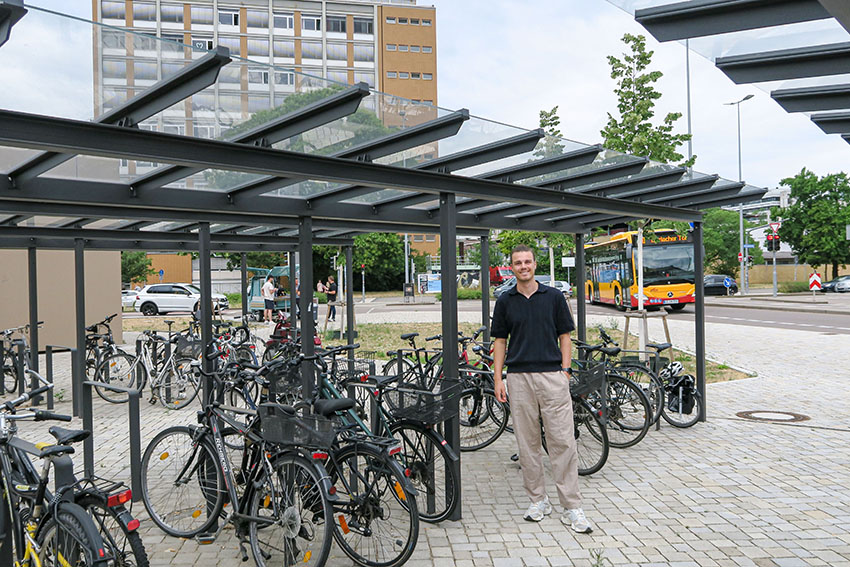
Hello Nicolas, please give us a brief introduction to the Institute for Transport Studies. What is your core area of focus?
We focus on the question of how we get around today and in the future. How will transportation change in cities, rural areas, and over longer distances, and how can it be organized as efficiently and environmentally friendly as possible? In doing so, we focus in particular on the interactions between different modes of transportation, for example, between cars, bicycles, and public transport.
We are investigating which factors influence mode choice and, based on this, can forecast future trends in mobility behavior. In doing so, we are laying an important foundation for the planning and further development of our transportation infrastructure.
What is your role in the KommMa project?
I develop various mobility measures for the KommMa database. In the application, we aim to offer as broad a spectrum of climate-friendly measures as possible. To reduce CO2 emissions, the shift to electric mobility in automotive traffic is a particularly important lever. However, an entire vehicle fleet cannot be electrified overnight. That’s why it’s also important to make climate-friendly modes of transportation, such as bicycles and public transit, more attractive and better integrated. This way, we can facilitate the transition to modes of transportation that are more sustainable.
In your opinion, what is the strength of the KommMa web tool?
Every municipality faces different challenges when it comes to mobility. In the Black Forest, for example, the conditions are quite different from those in the Rhine Valley. Our target is for the tool to reflect precisely this individuality so that every municipality can find the measures that suit its specific needs.
I see another advantage in the interfaces with the project’s partner institutes. For example, to effectively bundle measures related to charging stations, collaboration on energy issues is crucial. Within the project, we can interact effectively with ITAS, leverage synergies, and consider both aspects, transportation and energy, together from the outset. This is a clear added value for the tool.
Thank you very much for the interview!